Owltofinance fees for first bridge quotes and wallet costs
Last updated -
Owltofinance fees combine a percentage-based bridge charge with prepaid Destination TX Costs for the receiving network. Include both components and the source-chain gas your wallet requires when assessing your first quote. Read the quoted destination amount before signing. The bridge rate and destination payment can change with the selected route and network conditions, so an earlier quote doesn't establish the cost of a new transfer.
Asset, source network, destination network and recipient selections define the transfer you're pricing. ERC20 approval requirements can add a separate source transaction. If an approval transaction is needed, budget for its gas alongside the transfer transaction's gas.
The short version: In the EVM SDK flow, insufficient token allowance adds an approval transaction whose gas cost belongs in the transfer budget.
Bridge charges and prepaid destination payments
The bridge fee pays the platform and market makers a percentage of the transfer amount. Destination TX Costs prepay market makers for network fees on the receiving chain. A quote can therefore combine an amount-based charge with a destination-network payment. When the latter is fixed for a selected quote, it represents a larger share of a smaller transfer. The source-chain transaction also consumes gas, which your wallet must cover when it submits the transfer.
What needs to be ready before your first bridge quote?
Your asset, amount, source network, destination network and recipient must match the transfer you intend to price. The Bridge interface uses From for the source chain and asset, and To for the destination chain and receiving address. Check these selections before comparing fees, since a quote for one network path doesn't establish the cost of another.
Pair support applies to a token and a source-to-destination network path. A supported network alone doesn't make every asset transferable.
Transfer limits also belong to the selected pair. The SDK's pair information includes
minValue
and
maxValue
. Compare the requested amount with the applicable bounds before authorizing a transfer.
Read the quote in token units
The amount entered, the amount sent and the amount quoted for receipt describe different sides of the transfer. Read the fee values alongside them, keeping each amount's token unit clear.
Amounts on either side of the bridge
The source transaction amount
The build response has separate
inputValue
and
sendValue
fields, alongside
bridgeFee
and
gasFee
. Keep these returned amounts distinct when using an integration. The wallet confirmation identifies the source transaction's details. Its gas estimate also belongs in the balance you need to cover that transaction.
The quoted destination amount
The receiving amount describes the asset quantity the quote presents for delivery. Check its token unit before combining it with a fee figure. A dollar approximation expresses an estimated value; it isn't an additional token charge. Keep the quoted receiving amount available for comparison with the completed transfer.
The wallet's gas estimate
Source-chain gas pays for wallet transactions on the sending network. For an Ethereum source transaction, gas fees use ETH. A bridged ERC20 balance doesn't pay that gas charge by itself. Read the wallet's gas estimate before confirming, including any approval the wallet needs to submit.
Why can the fee differ when you request another quote?
A changed transfer amount affects the percentage-based charge, while destination gas conditions and route settings can affect the quoted cost. The platform bases fee adjustments on destination-network gas conditions, and those adjustments aren't frequent. Fee schedules can change, so a saved rate doesn't establish what a new transfer will cost. Compare quotes using the same asset, amount and network path to keep their basis consistent.
Manual settings offer a way to seek lower fees or faster delivery. Assess the new quote before choosing a route. Review the receiving amount as well as the displayed charge after changing settings. A lower percentage can still accompany a different destination payment, which belongs in the same cost comparison.
Bridge transactions beside other fee-bearing operations
Native-asset bridging and ERC20 bridging on EVM source chains can require different source transactions. If the EVM SDK returns an approval transaction, it comes before the transfer transaction. The EVM SDK omits the approval transaction when the existing token allowance is sufficient. That condition changes the source transactions your wallet needs to fund.
| Operation | Cost to account for | Applicable condition |
|---|---|---|
| EVM native-asset bridge | Bridge quote and source-chain gas | The wallet must fund the source transaction's gas. |
| ERC20 bridge requiring approval | Bridge quote plus approval and transfer gas | The wallet submits approval before transfer. |
| ERC20 bridge with sufficient allowance | Bridge quote and transfer gas | The existing allowance must cover the required transfer. |
| Contract deployment | Deployment-network gas | Basic and ERC20 deployment are separate operations from bridging. |
| Referral commission withdrawal | Listed minimum: 10 USDT; listed withdrawal fee: zero | These terms apply to referral commission withdrawals. |
Existing allowance removes the approval step in this SDK path; the bridge transfer still has its own quote and source transaction. Deployment and referral withdrawals have separate cost terms. A commission withdrawal minimum doesn't set a bridge-transfer minimum. Use the selected pair's limits for the transfer, and keep the referral account's withdrawal terms within their own scope.
Pausing at the quote and recognizing delivery
Quote review comes before Send and wallet confirmation, making it the place to pause before submitting a transaction. Leave the transaction unsigned if the displayed costs don't fit the intended transfer.
Signing authorizes the wallet transaction; submission can still precede source-chain inclusion. The status page uses Processing for an ongoing transfer and Success for a finalized transfer. Completed transactions have records on both source and destination chain explorers. The destination record identifies the receiving transaction, which you can compare with the amount the quote presented.
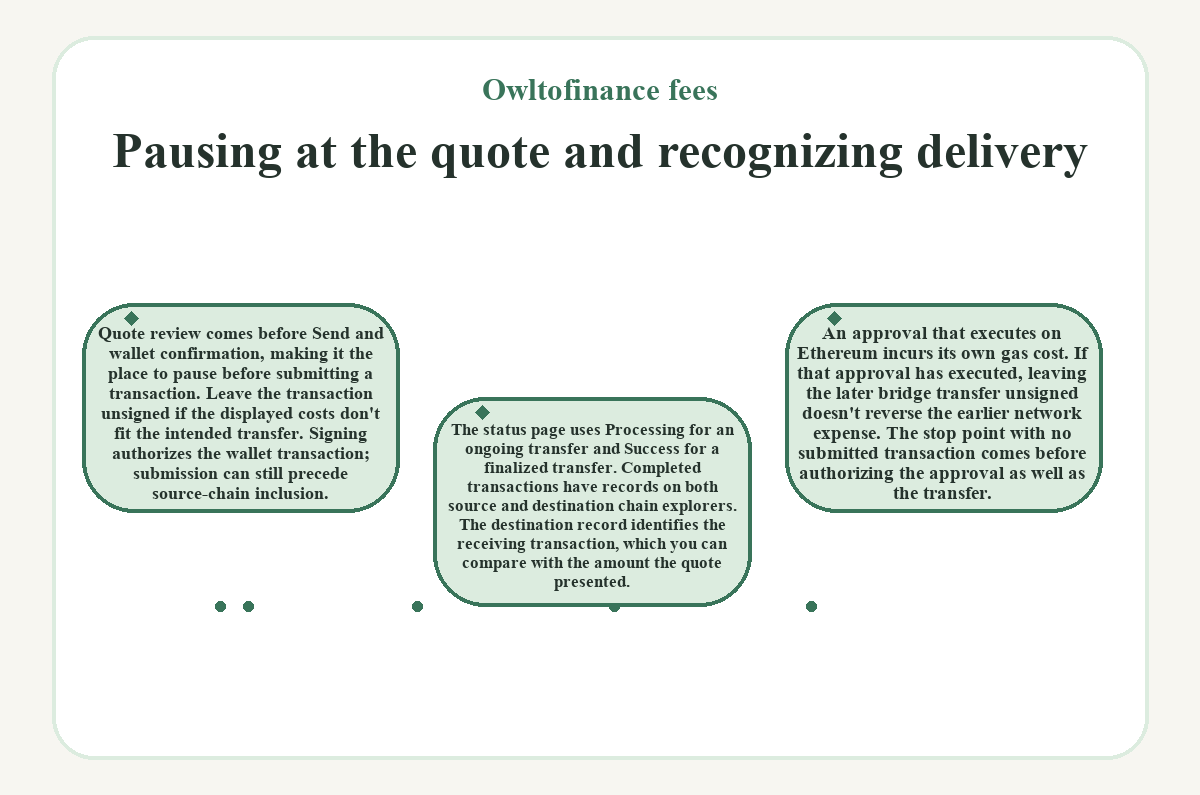
An approval that executes on Ethereum incurs its own gas cost. If that approval has executed, leaving the later bridge transfer unsigned doesn't reverse the earlier network expense. The stop point with no submitted transaction comes before authorizing the approval as well as the transfer.
Quote amounts beside settled transfer costs
The bridge receipt and source network's transaction record describe different parts of the completed cost. The SDK receipt response includes
userSendValue
,
userReceiveValue
and
toChainHash
. Its received-amount field belongs to the receipt response, while
receiveValue
belongs to the earlier build response. Keep the quoted amount separate from the reported receipt amount when reconciling a transfer.
Ethereum calculates a transaction's gas fee from the gas it used and its price per gas unit. This source-network expense differs from the prepaid destination payment. Match each amount to its own token unit when reconciling costs. A wallet gas estimate helps assess affordability before submission; the gas the transaction actually consumes determines the Ethereum network expense afterward.
Owltofinance fees: frequently asked questions
Can I use my full native-token balance for an EVM bridge transfer?
An EVM native-asset transfer needs enough remaining balance to pay the source transaction's gas fee. Choosing the entire balance as transfer value can leave the transaction unfunded. Account for the gas estimate your wallet shows before confirming. Paying the bridge fee and Destination TX Costs doesn't remove this source-side funding requirement.
What happens to the gas fee if my Ethereum transaction fails?
An Ethereum transaction consumes gas even when execution fails. The fee pays for computation the network performed, so failed execution doesn't return that gas charge to your wallet. Keep source-chain gas separate from the bridge fee and prepaid destination charge when assessing a failed attempt's cost. An ongoing cross-chain transfer and a failed Ethereum transaction also describe different states.
Does paying Destination TX Costs fund my next transaction on the receiving network?
Destination TX Costs pay for the market maker's delivery transaction. They don't by themselves establish a gas balance in the receiving wallet for a later transaction. The asset you receive and the native gas token the destination network requires are separate matters. For a later Ethereum transaction, gas fees require ETH. Check the receiving wallet's gas balance before planning another transaction with the bridged asset.
Who receives the rebate from a referred bridge transaction?
The inviter receives a rebate from the invitee's qualifying cross-chain transaction fee. The referral flow requires the invitee to connect a wallet and complete the transfer. Owltofinance credits the rebate to the inviter's commission account, keeping the commission separate from the assets delivered to the receiving address.
Is a receipt lookup error evidence that I need to pay another bridge fee?
A receipt lookup error can reflect a missing transfer hash, an ongoing bridge or a failed transfer. It doesn't establish that another payment is required. The SDK's receipt methods use the source transfer hash; an approval transaction has a different hash and purpose. Resolve the existing transfer's status before submitting another transfer, since a new source transaction can incur another gas charge.